
The Young Platform DeFi Wallet simplifies decentralized finance: this concise practical guide gives you all the information you need to make the most of it. Let’s get started (it takes just a moment)!
The DeFi Wallet is a new section within the Young Platform app that gives you straightforward, intuitive access to DeFi (decentralized finance) services. In this step-by-step guide, we walk through how it works: how to activate it, which crypto-assets you can use, how to make a deposit, how to unlock extra perks, and what the associated costs are.
The first step: activation, AML questionnaire, and KYC
The first step involves two administrative steps—slightly tedious, but very fast and essential for your protection and security in full compliance with current regulations: the AML questionnaire and KYC.
The AML questionnaire
What is the AML questionnaire? First, AML stands for Anti-Money Laundering. Its purpose is to ensure that access to on-chain services takes place in a regulated, compliant environment: it is a mandatory requirement and takes just 1 minute to complete.
KYC for new users
If you are a new user, before using the DeFi Wallet you must also complete KYC, which stands for Know Your Customer—meaning Level 1 identity verification (the same check required to operate on the main exchange platform).
What is its purpose? In short, KYC ensures that behind every account there is a verified, real person.
If you have already bought, sold, or deposited funds on Young Platform, you won’t need to complete this step again.
Which crypto-assets can you hold and which can you deploy in protocols?
The DeFi Wallet supports all ERC-20 tokens—meaning assets built on the Ethereum network—already available on Young Platform. This means you cannot transfer cryptocurrencies belonging to other blockchains (such as Bitcoin or Solana).
A quick note: technically, your wallet address can receive any token created on Ethereum; however, to shield you from scam tokens and malicious assets, the DeFi Wallet interface will display only the tokens that we have officially vetted and enabled.
Cryptos you can hold in the DeFi Wallet
In the DeFi Wallet, you can hold all cryptocurrencies listed on Young Platform—the same assets already available for buying, selling, or swapping on our core platform.
Cryptos you can “put to work” in protocols
Activities like lending are currently available for a curated selection of assets. The tokens currently supported across integrated protocols are:
- USD Coin (USDC) – a US dollar-pegged stablecoin (EMT)
- Euro Coin (EURC) – a euro-pegged stablecoin (EMT)
How do you deposit funds into the DeFi Wallet?
There are two ways to move your funds (crypto-assets or stablecoins) into the DeFi Wallet. Let’s look at each:
Method 1: from your Young Platform balance
If your liquidity is already sitting on the main platform, transferring it to the DeFi Wallet is quick and simple:
- Go to the Crypto section;
- Select DeFi Wallet;
- Tap Receive > Quick Deposit (from Young Wallet);
- Choose the crypto you want to transfer, specify the amount, and tap Confirm;
- Enter the two security codes prompted to proceed;
- Transfer complete! (it may take a few minutes to confirm on-chain).
Method 2: direct deposit from an external wallet
If you already hold crypto in another wallet (such as an external non-custodial wallet or an account on another exchange), you can deposit them directly into your DeFi Wallet. This is the most direct path for users who already operate on-chain.
Network fees (gas fees)
Network fees serve exclusively to compensate the blockchain network processing the transactions: that is why they are called gas fees. What you spend on network fees will always be displayed transparently in plain, easy-to-understand language.
For full transparency: Young Platform does not collect or retain any portion of network gas fees.
Security: why there is no “secret recovery phrase”
Anyone familiar with DeFi knows that creating a wallet traditionally involves receiving a seed phrase: a random sequence of 12 or 24 words that must be written down and carefully hidden, because it represents the sole key giving access to your funds. If you lose it, everything is gone.
The Young Platform DeFi Wallet does not use a seed phrase. Instead, it leverages a technology known as MPC (Multi-Party Computation), which splits the private key into multiple distinct shares, one of which remains locally on your device. This modern architecture does away with the vulnerable paper backup: with MPC, you access your DeFi Wallet via Face ID in just a few taps.
Naturally, even with MPC, the DeFi Wallet remains a strictly non-custodial wallet: the keys belong solely to you, and should you ever decide to, you can export and manage your wallet completely independently.
Differences with the classic Young Platform Wallet
Inside the app, you will find two distinct, intentionally segregated environments: your Young Wallet and the new DeFi Wallet. Here is how they compare.
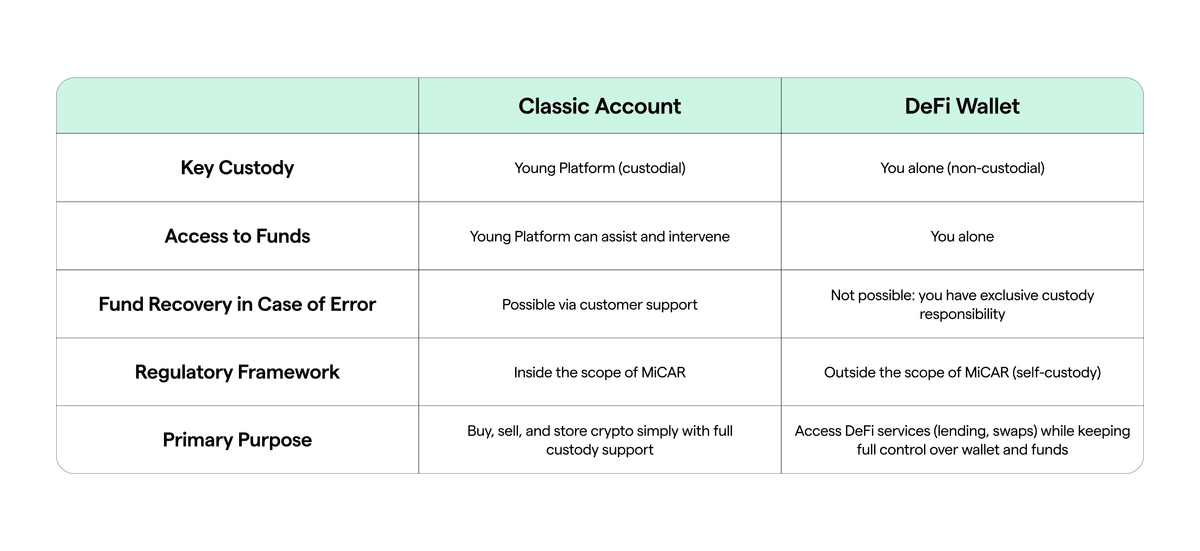
This is not a matter of deciding which option is “better”: these two distinct wallets live side by side inside the same app. You choose which one to use based on your individual goals.
Risk disclosure
The DeFi Wallet is a self-custody tool operating outside the regulatory perimeter of the MiCAR regulation. Because it is a non-custodial wallet, Young Platform does not hold your private keys and has no access to your funds at any time: you maintain sole responsibility for their custody. Consequently, Young Platform cannot recover your funds in the event of user error, lost access credentials, transfers to incorrect addresses, or improper transactions.
CryptCrypto-assets represent highly volatile, high-risk financial instruments. To review all associated operational and financial risks, consult the DeFi Wallet Risk Disclosure and the Service Terms and Conditions. Lending returns are variable, not guaranteed, and subject to protocol and smart contract risk. This guide is provided for educational and informative purposes only and does not constitute financial advice, investment recommendations, or an offer to buy financial instruments. Always evaluate your personal risk tolerance before participating.
Related Article


Download the Young Platform app