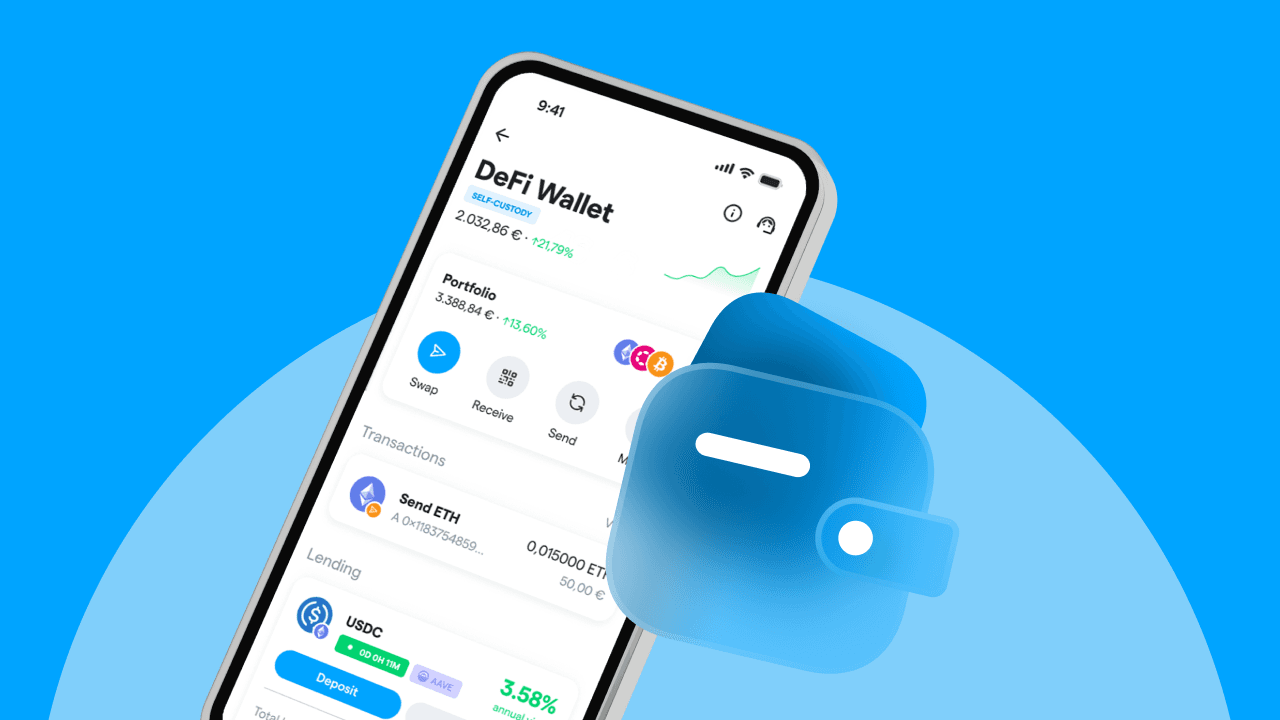
The bridge to entering DeFi without leaving the Young Platform app: a new way to explore decentralized finance simply and intuitively, while taking total control of your funds.
DeFi (decentralized finance), despite being an innovative environment rich in opportunities, often struggles to establish itself as a practical alternative to traditional finance. The core hurdle lies in its inherent operational friction: wallets that are difficult to configure, “secret seed phrases” to safeguard forever, seemingly hidden network gas fees, and the ever-present fear of making a single mistake and permanently losing your funds.
That is why we built the Young Platform DeFi Wallet
Here at Young Platform, we know DeFi inside and out. On the one hand, we know exactly how complicated it can be, especially for those unaccustomed to these types of mechanics. On the other hand, it is an undeniable fact that DeFi delivers massive advantages, chief among them the power to take genuine control of your funds and decide what to do with them without waiting for the approval of a bank or another third party.
The Young Platform DeFi Wallet is the seamless integration of these two realities: an intuitive way to access on-chain DeFi opportunities right within the app you already know and trust, while retaining full control of your crypto-assets.
In this guide, we will take a quick look at the practical applications and use cases of DeFi, before breaking down how the Young Platform DeFi Wallet works and how it unlocks this ecosystem for you.
DeFi: practical applications and use cases
DeFi is not “one single product”. DeFi is an ecosystem of automated financial services accessible to anyone in possession of a wallet (such as the Young Platform DeFi Wallet).
What do we mean by “automated” financial services? In short, DeFi financial services are “automated” because they are governed by computer programs running on blockchains, known as protocols.
To better grasp the concept, think of DeFi as your smartphone and these financial services as the apps installed on it. The phone “hosts” various apps that nevertheless have their own independent lifecycle, separate from the operating system. Just as the Young Platform app runs independently within iOS or Android, these automated financial services operate independently inside the DeFi ecosystem.
What are the most common activities in DeFi?
Lending
You supply your crypto-assets to a protocol, which lends them out to market participants in need of liquidity. In return, you receive interest. Examples: Aave, Morpho.
Borrow
The opposite of lending: you obtain liquidity by locking up your crypto-assets as collateral. Borrowing allows you to unlock capital without having to sell Bitcoin, Ethereum, or your existing holdings. Examples: Aave, Morpho.
Staking
You “lock up” certain crypto-assets to help secure and validate transactions on a blockchain network, and in return, you receive periodic rewards. This is a mechanism you may already be familiar with: it has long been available natively on Young Platform as well.
Liquid staking
An evolution of traditional staking: you stake your crypto, but in return you receive a “token” that acts as a digital “receipt”: it certifies that your assets are actively staked while reflecting their underlying value. This is a powerful feature because this receipt token can be deployed across other protocols to generate additional yields.
It is pure capital efficiency: similar to taking out a mortgage, purchasing a rental property, and using the rental income to service the mortgage—only far less bureaucratic. Examples: Lido, Rocket Pool.
Swap
You exchange one crypto-asset for another. It functions just like exchanging Euros for US Dollars at a currency exchange booth, but handled programmatically, settled in seconds, and typically at much lower fees. It takes place on decentralized exchanges, known as DEXs. Examples: Uniswap, Curve, CowSwap.
Yield Farming (liquidity provision)
You supply liquidity to one or more DEXs by depositing a trading pair of crypto-assets into a liquidity pool, which serves to facilitate the swaps described in the section above.
For instance: to allow users to swap USDC for EURC, the protocol must hold sufficient reserves of both USDC and EURC. Yield farming fulfills this exact role: by depositing 10 USDC and 10 EURC into the USDC/EURC pool, you contribute to the DEX’s liquidity and ensure swaps execute seamlessly.
Through Yield Farming, you become a liquidity provider: thanks to you (and others who supply liquidity to the protocol), market participants can convert their crypto.
In return, you earn a portion of the trading fees paid by those who swap. While attractive, it carries an additional structural risk you must understand, known as impermanent loss: the relative prices of the two deposited assets may diverge, leaving you with less overall value than if you had simply held them individually. Examples: Uniswap, Curve.
Real World Assets (RWA)
The fastest-growing frontier: bringing real-world instruments on-chain, such as funds invested in government treasury bonds. A prime example is Spiko, which tokenizes money market funds backed by European and US sovereign treasury bills – RWA: what they are and how they work
Advanced activities
DeFi also includes more intricate and speculative mechanisms, such as derivatives (contracts tracking underlying price movements), designed for experienced investors and carrying higher risk profiles: these are best approached only after mastering the foundational concepts.
Across every use case, the common thread is identical: you operate autonomously, relying on fully transparent, open-source protocols, replacing services traditionally brokered by legacy intermediaries.
The Young Platform DeFi Wallet is purpose-built to give you straightforward, secure access to this frontier: today, our DeFi Wallet lets you participate in the two most widely adopted DeFi primitives—lending and swaps. Moving forward, it will continue to evolve: our engineering team is already hard at work on the next integrations.
What is a DeFi Wallet?
Before defining what a DeFi Wallet is, it helps to briefly recap what a crypto wallet is in general. A crypto wallet is a tool that enables you to send and receive crypto. Wallets fall into two distinct categories:
- Custodial wallets. Private access credentials are managed by a third party, such as a centralized exchange. It is convenient, but technically speaking, custody of the assets is delegated to the platform.
- Non-custodial wallets (self-custody). You alone control the keys. This means no one—not even the infrastructure provider—can move your funds on your behalf.
The Young Platform DeFi Wallet belongs to this second category: it is non-custodial, meaning that you always retain total, uncompromised control of your crypto-assets.
Inside our app, this boundary is intentional and explicit: there is a distinct separation between the Crypto section (the centralized platform, where Young Platform provides custodial safeguarding and core fiat ramps) and the DeFi section (the on-chain self-custody wallet, where your funds remain exclusively in your hands).
DeFi and Young Platform: what is our role?
This is a critical distinction to establish from the start: Young Platform is not an intermediary, but serves as your bridge to DeFi.
As illustrated with the phone-and-app analogy: protocols such as Aave, Morpho, or Maple are independent third-party services separate from Young Platform. The yields they generate are programmatic protocol dynamics, variable, non-guaranteed, and dependent upon underlying market forces.
Our role, as emphasized earlier, is to offer you an intuitive, accessible, and transparent gateway into the DeFi landscape.
The Young Platform DeFi Wallet was created specifically to eliminate the friction points that make DeFi inaccessible for most people: key management headaches, network gas fees, complex user interfaces, and impenetrable technical jargon.
We provide the underlying infrastructure, simplified and optimized for a fluid user experience, but the final decision always belongs strictly to you: you evaluate, decide, and act on your own terms.
The advantages of accessing DeFi inside Young Platform
Navigating DeFi completely on your own is entirely possible, but it is also cumbersome and, for many, fraught with operational risk.
Accessing DeFi via Young Platform, on the other hand, transforms the experience for the better across several dimensions:
Everything inside a single app
This is arguably the greatest benefit. In one unified app, you have access to a trading platform to buy and sell crypto, a payment account for everyday financial activities, and now direct access to DeFi.
Forget connecting clunky browser extensions, transferring assets back and forth between disparate services, or jumping across multiple apps. Everything is consolidated in one place, right inside your Young Platform app.
Only curated protocols
To reiterate: here at Young Platform, we understand DeFi deeply, including both its opportunities and its systemic risks. For this reason, we integrate only select, rigorously assessed protocols, chosen based on their track record, operational maturity, liquidity depth, and infrastructural stability.
DeFi is an ocean; the DeFi Wallet is your vessel to navigate the waves—but you remain the Captain.
The first DeFi experience with native local-language support
DeFi has traditionally been an environment where customer support simply does not exist: because it is decentralized and lacks a central management team, whenever an issue arises, you are left to figure it out on your own—hoping to stumble across a helpful Reddit thread or Discord channel discussing your exact problem.
Young Platform brings to DeFi what DeFi has always lacked: dedicated human customer support in your native language, backed by real professionals. It is the difference between exploring an unfamiliar frontier alone versus having experienced specialists by your side.
Zero network gas fees to manage manually
Every transaction executed on a blockchain incurs a network fee, known as a “gas fee“, traditionally paid in the native currency of that specific network—on Ethereum, for example, gas must be paid in ETH. This means you are forced to hold specific crypto reserves solely to pay gas and execute any on-chain action.
The Young Platform DeFi Wallet removes this operational friction by allowing you to choose which asset you use to settle network fees. Furthermore, prior to confirmation, you review the exact cost in Euros (or YNG): confirmations are written in clear, plain language, leaving technical jargon behind.
Your funds remain entirely yours, without the headaches
Even though the Young Platform DeFi Wallet is non-custodial, you do not need to write down a 12- or 24-word seed phrase on a piece of paper to hide away forever. Our DeFi Wallet leverages MPC (Multi-Party Computation). How does it work?
In short, the private key governing your wallet never exists in any single location: it is divided into multiple cryptographic key shares, one of which resides directly on your personal device, strictly under your control. Consequently, no transaction can ever be initiated or signed without the complete key assembly, which requires your explicit authorization.
If you ever wish to export and manage your wallet completely independently outside the app, you can easily claim full ownership of your private keys with a single tap.
How to use it in practice
The philosophy driving our DeFi Wallet is simple: “intuitive accessibility first, advanced technical control whenever you are ready.”
You can activate your DeFi Wallet in just a few steps using Face ID and a brief questionnaire; from there, you can interact with lending protocols, execute on-chain swaps, and monitor your assets and transaction history with granular visibility.
If you’ve read this far, you’re ready to explore. Find everything you need at this link: How to use the Young Platform DeFi Wallet?
Everything inside the same app, clear and accessible.
In summary
The Young Platform DeFi Wallet is a non-custodial wallet that grants you seamless, intuitive access to the world of DeFi, hosted within a secure and familiar ecosystem, ensuring you always retain exclusive custody over your assets—backed, for the first time, by dedicated support ready to guide you.
Risk disclosure
The Young Platform DeFi Wallet is a self-custody solution operating outside the regulatory framework of the MiCAR regulation. Because this is a non-custodial wallet, Young Platform does not store your private keys and has no administrative access to your digital assets: you maintain sole responsibility for their security and safeguarding. Consequently, Young Platform cannot recover assets lost due to user error, forgotten or misplaced access credentials, misdirected transactions, or improper protocol interactions.
Crypto-assets represent highly volatile, high-risk financial instruments. To review all associated operational and financial risks, consult the DeFi Wallet Risk Disclosure and the Service Terms and Conditions. Lending returns are variable, not guaranteed, and subject to protocol and smart contract risk. This guide is provided for educational and informative purposes only and does not constitute financial advice, investment recommendations, or an offer to buy financial instruments. Always evaluate your personal risk tolerance before participating.
Related Article

Download the Young Platform app