EURC, the euro-pegged stablecoin compliant with MiCAR regulations, is officially listed on Young Platform. Discover what it is, its DeFi applications, and how it differs from USDC.
Almost all stablecoins are pegged to the US dollar. Anyone who operates in euros and uses dollar-pegged stablecoins like USDC or USDT must contend with a hidden risk component: the euro-dollar exchange rate. If the dollar weakens, the euro value of your capital drops, regardless of crypto market movements.
EURC was created to eliminate this exposure. Let’s look at what EURC is, why it is more important than it appears, and how it is used in DeFi.
What is EURC?
EURC is a stablecoin pegged 1:1 to the euro (1 EURC = 1 euro) issued by Circle, the same company behind USDC, which holds reserve assets backing it. This means that for every circulating EURC, Circle holds one euro in its reserves. In fact, the whitepaper states that “EURC is backed by an equivalent amount of euro-denominated assets held by Circle SAS and is redeemable 1:1 in euros“.
Circle is authorized in the European Union as an electronic money institution (EMI), defined by the Bank of Italy as “undertakings, other than banks, that issue electronic money” under the MiCAR Regulation. EURC is therefore one of the electronic money tokens (EMT, Electronic Money Token) issued by Circle. In other words, EURC is a stablecoin fully compliant with the European market.
What EURC is NOT
EURC is not a bank deposit in euros, but a digital version of the euro backed 1:1, as we just saw, by the reserves of the issuer Circle. Now, Circle is not a bank, but an EMI: this means there is no statutory deposit guarantee scheme, such as the FITD (Interbank Deposit Protection Fund) in Italy, to compensate a bank’s clients—up to €100,000 per depositor—in the event of bank insolvency.
This is a risk to evaluate carefully in its entirety. The MiCAR Regulation introduces very significant investor protections, but it is essential to keep in mind that holding EURC issued by Circle is fundamentally different from holding a bank deposit.
EURC: why a euro stablecoin is essential
In a digital landscape dominated by US dollar-pegged stablecoins, having EURC available is a major milestone. For a European user who earns and spends in euros, EURC means being able to move in and out of on-chain liquidity without being exposed to FX risk every single time.
How much does currency risk matter? A practical example
Imagine living in Italy and having €10,000 sitting in your account: you want to put it to work on a DeFi protocol that doesn’t support EURC. As a result, you must convert your euros into USDC. You execute the swap at an exchange rate of €1 = $1.162: your €10,000 becomes 11,162 USDC.
Let’s assume the APY (Annual Percentage Yield), meaning the interest the protocol provides in exchange for depositing your USDC, is 3%. You decide to leave it there for one year.
Twelve months pass, and you return to withdraw your funds, which have now grown to 11,497 USDC (11,162 initial USDC + 335 USDC in accrued interest). You decide to convert back to euros, but during this period, the dollar has weakened: at the time of the swap, €1 = $1.185, and you receive €9,702.10. Final result: you lost €297.90 on your original €10,000.
EURC vs USDC: the key differences
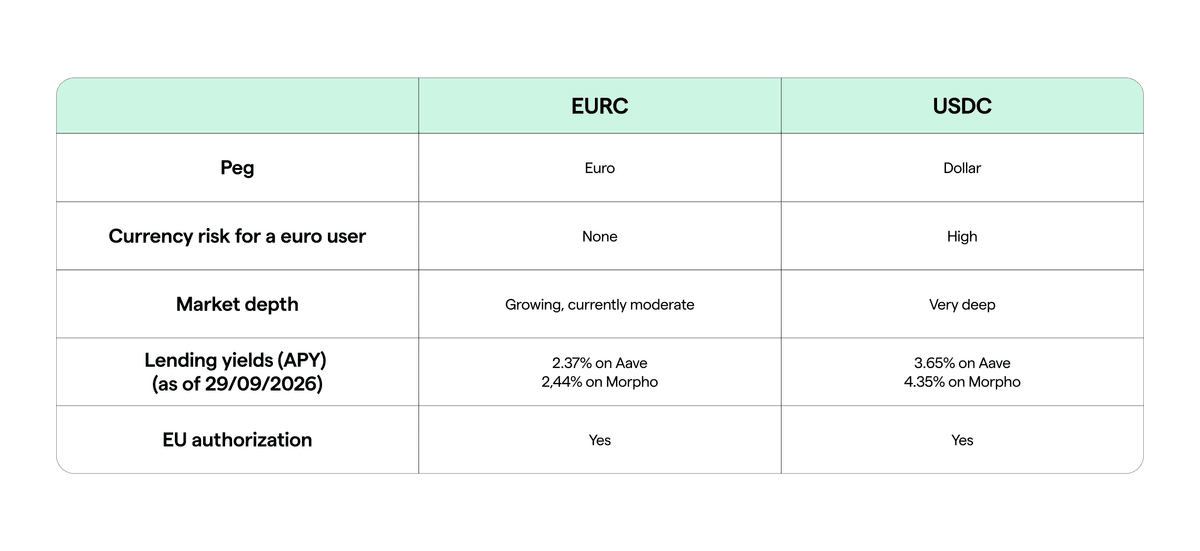
The choice between EURC and USDC comes down to a trade-off between:
- Greater versatility with USDC, which is currently ubiquitous, with deeper liquidity pools and higher lending rates;
- Parity between the euro and EURC: since €1 = 1 EURC, currency exchange fluctuations are completely eliminated.
For those residing in the eurozone and living in euros, the second argument may easily outweigh the first. It is an individual assessment.
EURC in DeFi
There are active EURC lending markets on Aave and Morpho: you supply EURC and, in return, earn interest based on a variable rate, with no lock-up periods. To date, Aave and Morpho are among the few protocols in DeFi that allow you to manage on-chain liquidity entirely in euros—subject, of course, to the classic risks inherent to smart contracts.
How to get it
EURC can be purchased on authorized platforms or obtained via on-chain swaps. Young Platform provides direct access to DeFi through the DeFi Wallet: convert to EURC and safeguard it with your own private keys.
Risk disclosure: EURC carries issuer risk and is not covered by statutory deposit guarantee schemes. DeFi services involve smart contract and protocol risks; yields are variable and not guaranteed. The DeFi Wallet is a self-custody tool operating outside the scope of MiCAR. This content is for informational purposes only and does not constitute financial advice or a solicitation to purchase. To review all associated operational and financial risks, consult the DeFi Wallet Risk Disclosure and the Service Terms and Conditions.
Related Article


Download the Young Platform app