DeFi Wallet
The differences between the “traditional” system and DeFi: lock-ups, penalties and redemption windows
Giuseppe Avolio
5 min
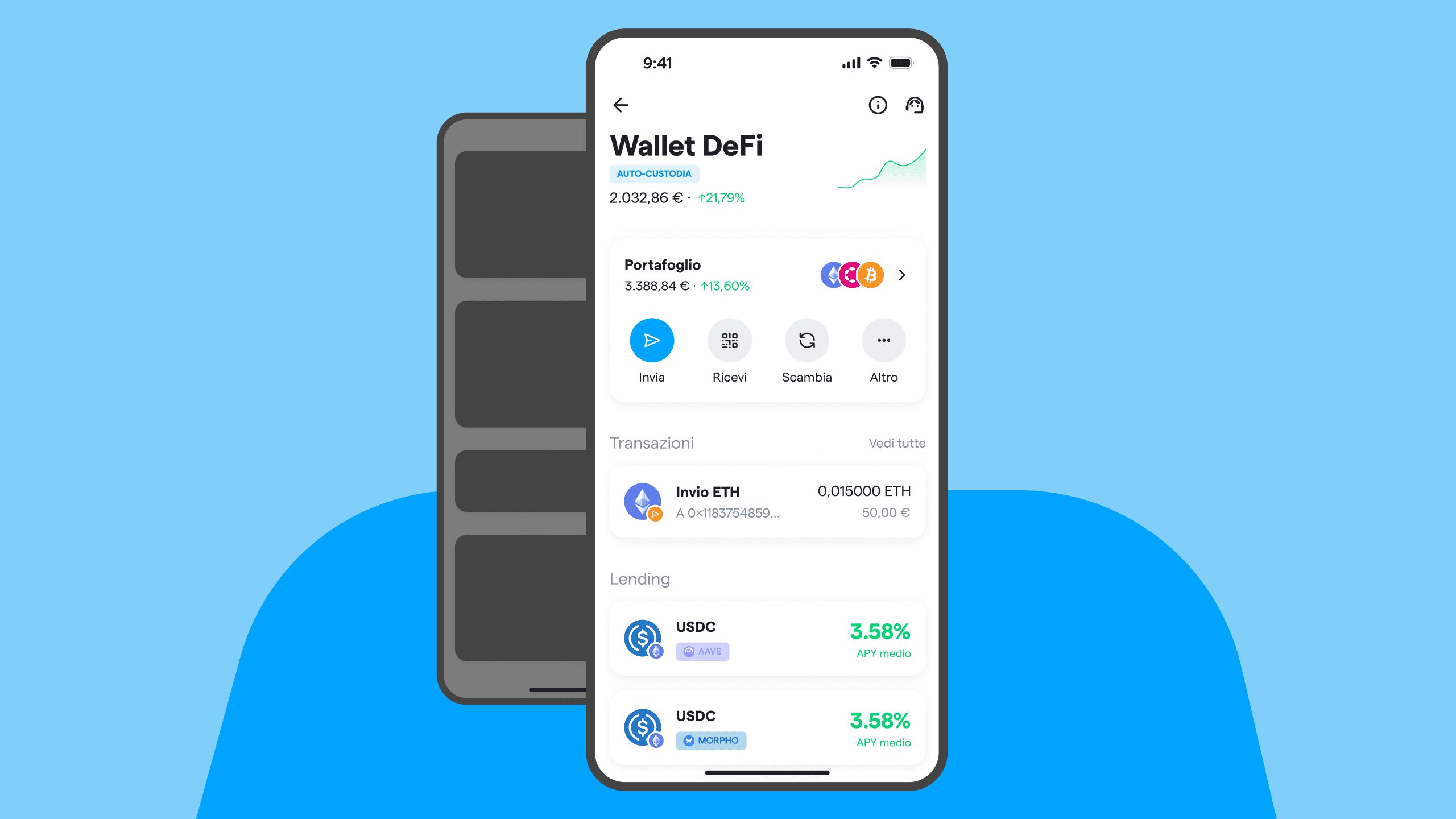
Want to put your idle cash to work? In this article we show you some key differences between “traditional” instruments and DeFi (decentralized finance) protocols.
When choosing a way to make the most of your cash, one of the most common questions is: “how much does this instrument yield?”. The question almost nobody asks, however, is: “under what conditions can I get my money back?”. Yet the answer to the latter is just as important: a potentially high yield can shrink considerably if, for example, you have to pay penalties to obtain it. Both the “traditional” system and DeFi offer many instruments to make your money work, but with different rules. Here we show you the main differences.
The three keywords: lock-up, penalty, window
When comparing instruments, it’s essential to focus on three recurring terms, often written in small print, but decisive.
- Lock-up: the period agreed between the parties – whoever deposits the cash and whoever offers the yield – during which the capital must remain locked in order to access the reward (for example: 12, 24, 36 months).
- Penalty: what you have to pay if you want to exit before maturity without respecting the lock-up: usually this means losing all or part of the accrued interest, or having a portion of the deposited capital withheld.
- Redemption window: the moment (or moments) when you can actually get your money back.
Lock-up, penalty and redemption window are three different ways of saying the same thing: when you put it to work, your money isn’t always available at any time, and there are conditions to take into account. Not respecting them very often comes at a price.
The logic of the “traditional” system
In this respect, traditional instruments almost all follow the same reasoning: yield is inversely proportional to availability. In other words: to get a higher return, you’ll most likely have to lock up your money for longer. Let’s look at a few examples.
A fixed-term deposit account usually offers a very good interest rate but, at the same time, requires a lock-up (usually no less than 12 months). To release your funds early, where possible, you’ll almost certainly have to factor in paying a penalty or losing the accrued interest.
An easy-access deposit account, on the other hand, yields much less precisely because it doesn’t require any lock-up: you can deposit and withdraw your money at any time.
Government bonds, such as the well-known Italian BTPs or German Bunds, have a secondary market: this means that, in theory, you can sell them before maturity. In that case, however, you are exposed to the market price at that moment, which may be lower – or higher – than the purchase price.
The mechanics of DeFi: lending
In DeFi (decentralized finance), lending – lending money in exchange for a yield – works according to a different dynamic: there are no contractual maturities. In DeFi, in fact, you can deposit stablecoins (EMTs) in a protocol such as Aave or Morpho, and withdraw them whenever you want, depending on the liquidity available in the protocol* at that moment: there is no minimum term, no early-withdrawal penalties, no predefined redemption windows.
Consistently, the APY (Annual Percentage Yield) is not fixed but variable. The APY, in fact, is determined by one of the fundamental laws of economics: the meeting of supply and demand for capital on the on-chain market, not by a contractual clause. And throughout this time, the funds remain in a wallet you hold custody of, not with an intermediary.
*Why did we put an asterisk on “depending on the liquidity available in the protocol”? The answer is simple. Lending, as we wrote just above, is defined as “the act of granting money, goods or an asset to another person or organization for temporary use, with the expectation that it will be returned, usually with an additional sum as interest”.
Therefore, by definition, it’s possible that a large part of the liquidity deposited by users in a given protocol has actually been lent to borrowers and is therefore not immediately available. It’s neither a penalty nor a loss: it’s a wait, usually short, linked to how the market is moving at that moment. It’s the natural, transparent equivalent of the redemption window in the “traditional” system.
The comparison
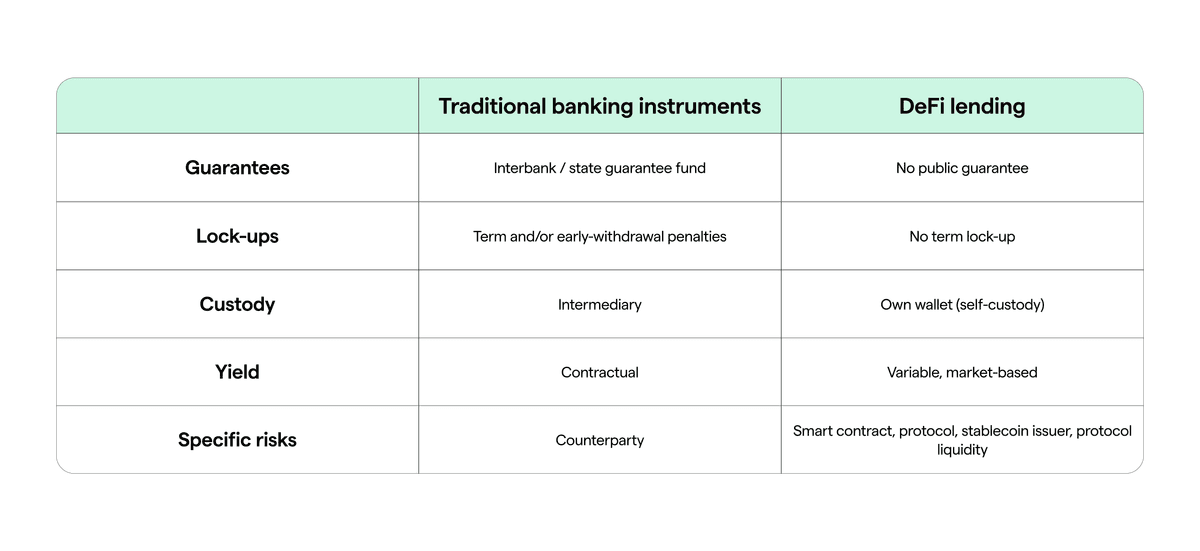
It’s worth spending a minute on the last row, the one about guarantees: decentralized finance, by its very nature, does not provide public guarantees. DeFi is, precisely, decentralized and therefore lacks a central body that could act as guarantor and, at the same time, exercise direct control over it.
In the “traditional” system, you lock up your money with an intermediary who, in return, provides you with guarantees. In DeFi, by contrast, you gain freedom of action and direct custody of your money, but without guarantees. You are fully in charge of your own decisions.
For these reasons, the choice of one or the other should always be the result of a careful personal assessment, made with full awareness of the costs and benefits.
How to get started
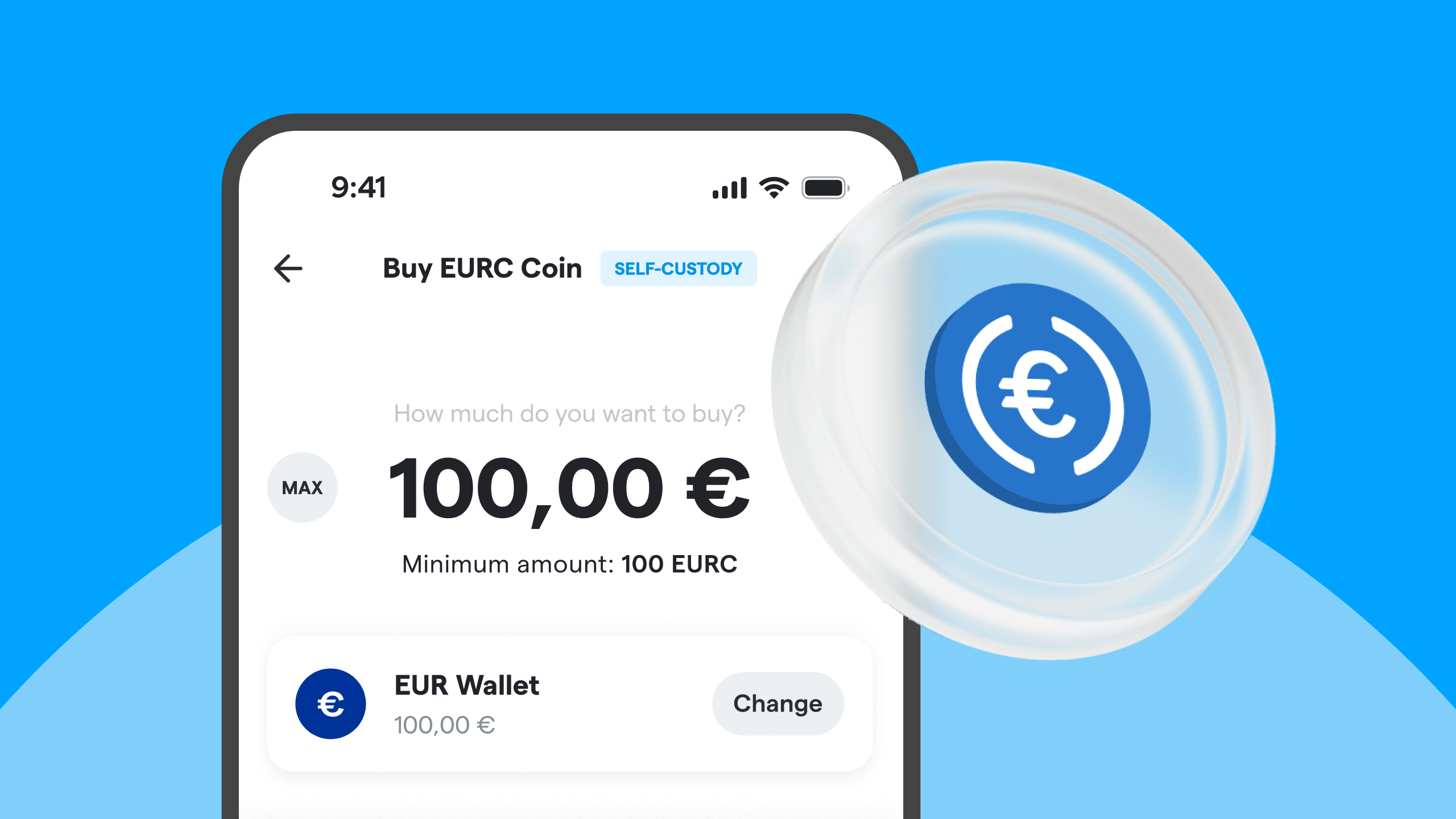
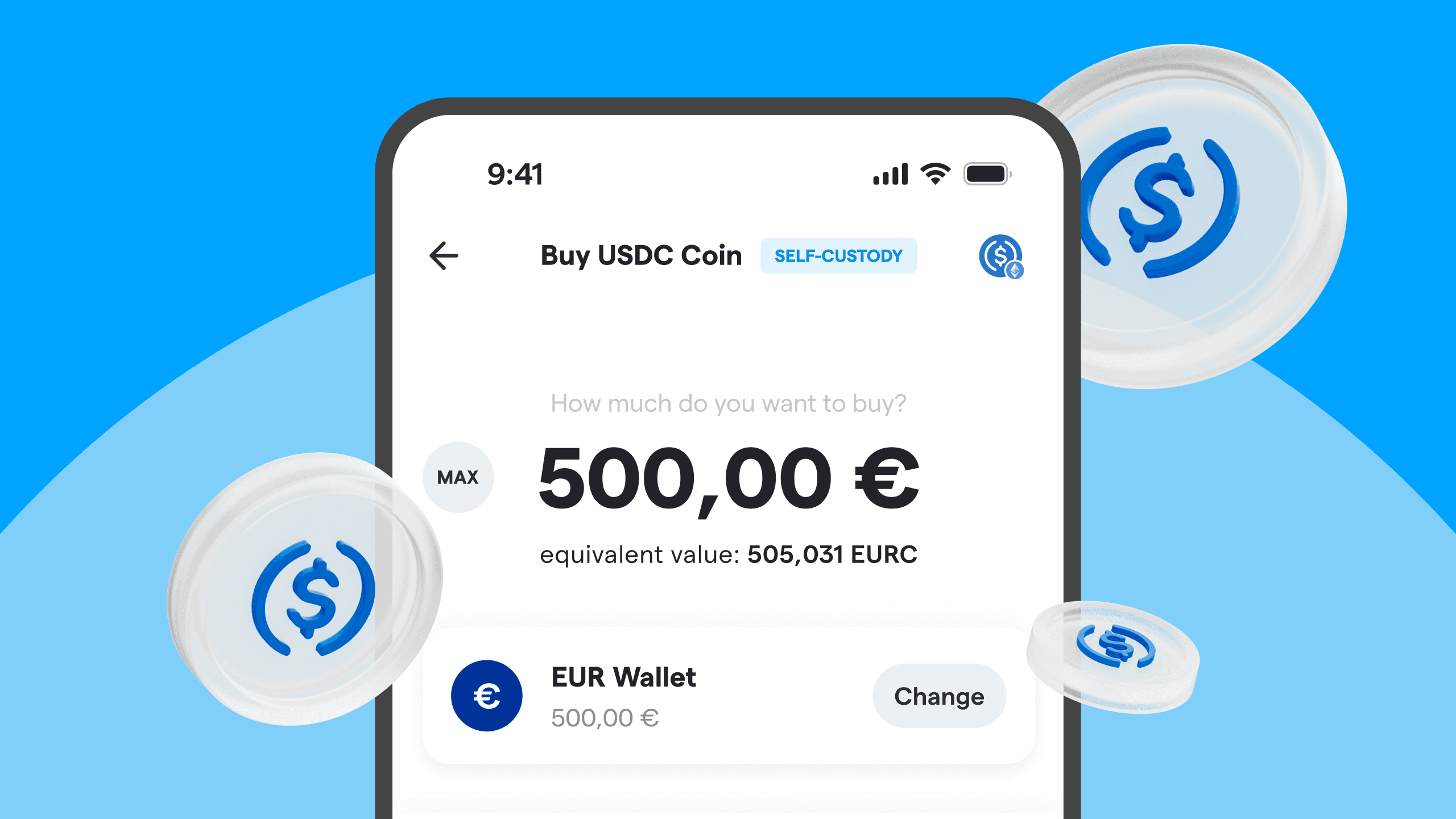
To access lending in DeFi you need stablecoins, such as USDC in dollars or EURC in euros, and a non-custodial (self-custody) wallet.
For the vast majority of people, one of the main barriers to entering DeFi is its technical complexity: many avoid it because most protocols seem designed exclusively for insiders.
Young Platform solves this problem: our DeFi Wallet is a non-custodial wallet built to make access to this world of opportunities simpler. Open the app (or download it from your store) and take a look: swap (conversion), transfer and lending in a few clear steps, with human assistance and support in Italian to turn to whenever you need it.
Young Platform’s DeFi Wallet is a self-custody tool and operates outside the scope of the MiCA Regulation (MiCAR). As a non-custodial wallet, Young Platform does not hold your private keys and never has access to your funds: you are solely responsible for their safekeeping. Consequently, Young Platform cannot recover your funds in the event of errors, loss of access credentials, transfers to a wrong address or incorrect transactions.
Crypto-assets are high-risk and volatile instruments. To review all the associated risks, see the DeFi Wallet Risk Disclosure and the Terms and Conditions of Service. Lending yields are not guaranteed and may vary. There are risks related to smart contracts and to individual protocols. This content is for information purposes only and does not constitute financial advice or an invitation to buy. Always assess carefully, based on your personal situation.
Related Article

Download the Young Platform app