The third quarter 2026 report on the YNG token: a new trading venue, a new way to buy and hold it, and one to use it.
What happened to the YNG token between July and September? Where can it be traded and what benefits does it unlock today, compared with three months ago? And how did the price move?
Young Platform’s third quarter of 2026
If we had to sum up this quarter in one sentence, it would be this: YNG found three new paths. A new market, WhiteBIT, where since 28 July the token can be traded alongside Young Platform and Uniswap. A new way to buy and hold it, Young Boost, the vesting service that rewards with extra tokens those who choose to lock their YNG over time. And a new use case, linked to the DeFi Wallet, where since the end of September YNG can be used to pay network fees with a dedicated discount.
Meanwhile, month after month, the Young card kept doing its quieter job: distributing YNG to the users who spend with it. Over the quarter, cashback distributed 47% more tokens than in the previous three months and became by far the main source of new YNG in circulation. A sign that the Young card is being used more and more. All this in the first quarter spent entirely as a MiCAR-authorised platform, from the first day to the last.
Let’s start with the price, then move on to everything else: the three new paths, the tokens distributed, the Buyback Programme, the Clubs, and one piece of news that doesn’t concern the token but concerns many of you: at the beginning of 2027 Young Platform will become a tax withholding agent, applying the administered tax regime to crypto-assets. The complete data, with the on-chain addresses and the regulatory references, are in the official informational communication, published alongside this report.
The price of YNG
Over the quarter, YNG went from €0.574 on 30 June to €0.503 on 30 September: -12.3%.
July was the liveliest month: the token reached the high of the period, €0.633, on 27 July, on the eve of its arrival on WhiteBIT, and closed the month up 3.3%. August and September followed with a settling phase, with the price moving between €0.49 and €0.59.
These are historical data: the price of YNG can rise and fall, even sharply, and past performance is not indicative of future performance.
Three new paths for YNG
A new market: WhiteBIT
Since 28 July, YNG can also be traded on WhiteBIT, on the YNG/USDC pair. It is the first time the token has arrived on a third-party centralised platform: until July it was traded on Young Platform and, since 2025, on the decentralised Uniswap pools.
WhiteBIT has strong roots in Eastern Europe, an area where Young Platform is still little known: for YNG it means a new community, different from ours, and one more trading venue.
One important clarification: WhiteBIT’s European platform has not been launched yet, so for now residents of the European Union cannot trade YNG on WhiteBIT. And, as always, an admission to trading is an infrastructure matter, not a promise about the price, and it changes neither the tokenomics nor the holders’ rights described in the White Paper.
A new way to buy and hold it: Young Boost
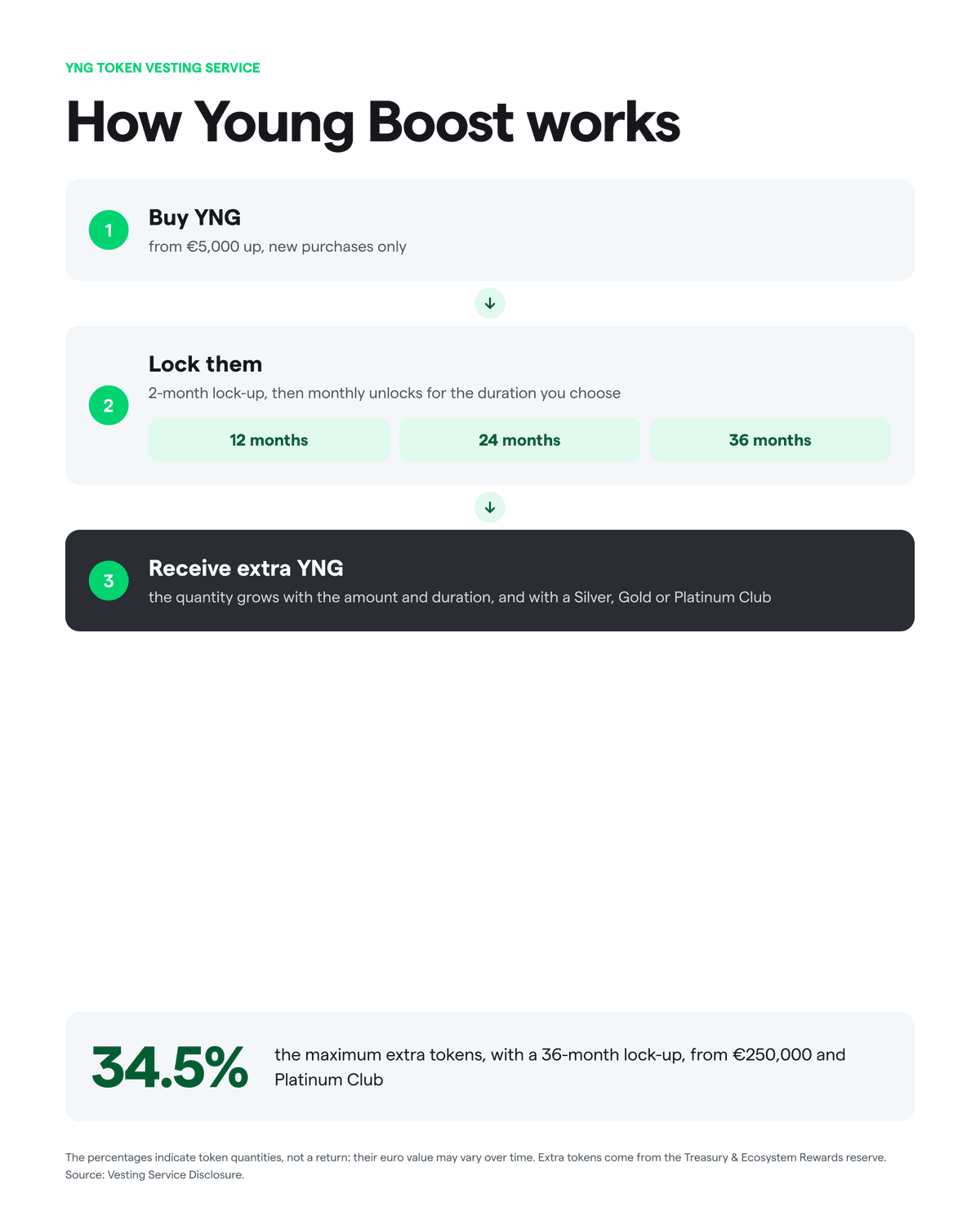
In July we launched Young Boost, the YNG token Vesting Service, designed for those who choose a long time horizon. It works in a straightforward way: you buy YNG on the platform, from €5,000 upwards, you lock them for a period of your choice (two months of initial lock-up, then a monthly release over 12, 24 or 36 months) and you receive an additional quantity of tokens, which follows the same schedule.
How many extra tokens? It depends on the amount and on the length of the lock-up, and those with a Silver, Gold or Platinum Club get an additional Club Bonus: it goes up to 34.5% extra YNG, with a 36-month lock-up, from €250,000 and a Platinum Club. It is neither a return nor interest: these are tokens that Young Platform, as issuer, allocates from the Treasury & Ecosystem Rewards reserve, and their value in euros can change over time. Young Boost applies only to new purchases, and all the conditions are in the Vesting Service Information Notice.
A new way to use it: the DeFi Wallet
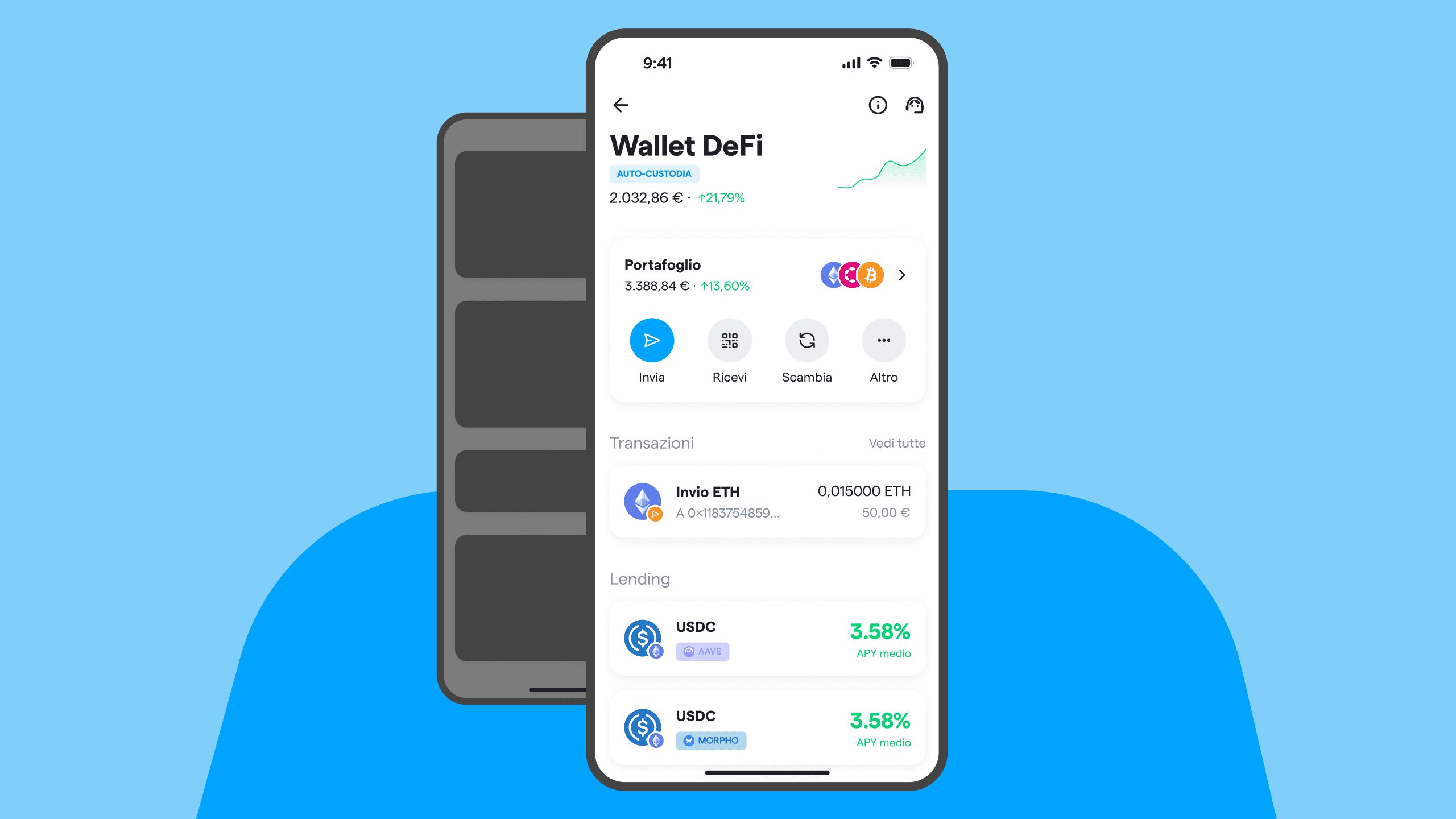
On 28 September we released the first version of the DeFi Wallet to Club members, and since 7 October it has been open to everyone.
Until then, to use decentralised finance protocols you had to leave the app, open an external wallet and learn how to manage it. Now everything happens in the app you already use: it is a self-custody wallet, the keys stay in your hands and we provide the interface.
From there you can access selected lending protocols, today Morpho and Aave, where you can deposit USDC and EURC. The next step is to bring Bitcoin too and other crypto-assets into the wallet: the goal is to make it possible, by early 2027, to use your BTC in lending protocols, as you do today with USDC and EURC. This is forward-looking information: timing and terms may change, and the return of the protocols is never guaranteed.
This is where YNG’s new practical utility comes into play. The network fees of transactions can be paid in USDC, EURC, ETH or YNG, and those who pay in YNG get a discount, which grows with the Club level. Club members also get a discount on the fee applied to protocol returns.
The DeFi Wallet is outside the scope of MiCAR, and the protections of the regulation do not apply to what you do with your keys. Using DeFi protocols involves specific risks, including those related to smart contracts.
Account and card: the effect on the token
The debit card and payment account were the real drivers of YNG circulation this quarter. Through YNG cashback on spending, 49,905 YNG were distributed, compared with 33,839 in the previous quarter: +47%. The mechanism is the one you know: every purchase gives back a share in YNG, with a percentage that grows with the Club level (up to 3.6%), and the more the card is used, the more YNG reach the wallets of those who use it.
Then there is a less visible mechanism: 0.15% of every card payment goes directly to the Buyback Programme. The other three sources that make up the periodic buyback and liquidity injection mechanism are staking fees, decentralised pool fees and Young Platform Step.
How many YNG were distributed
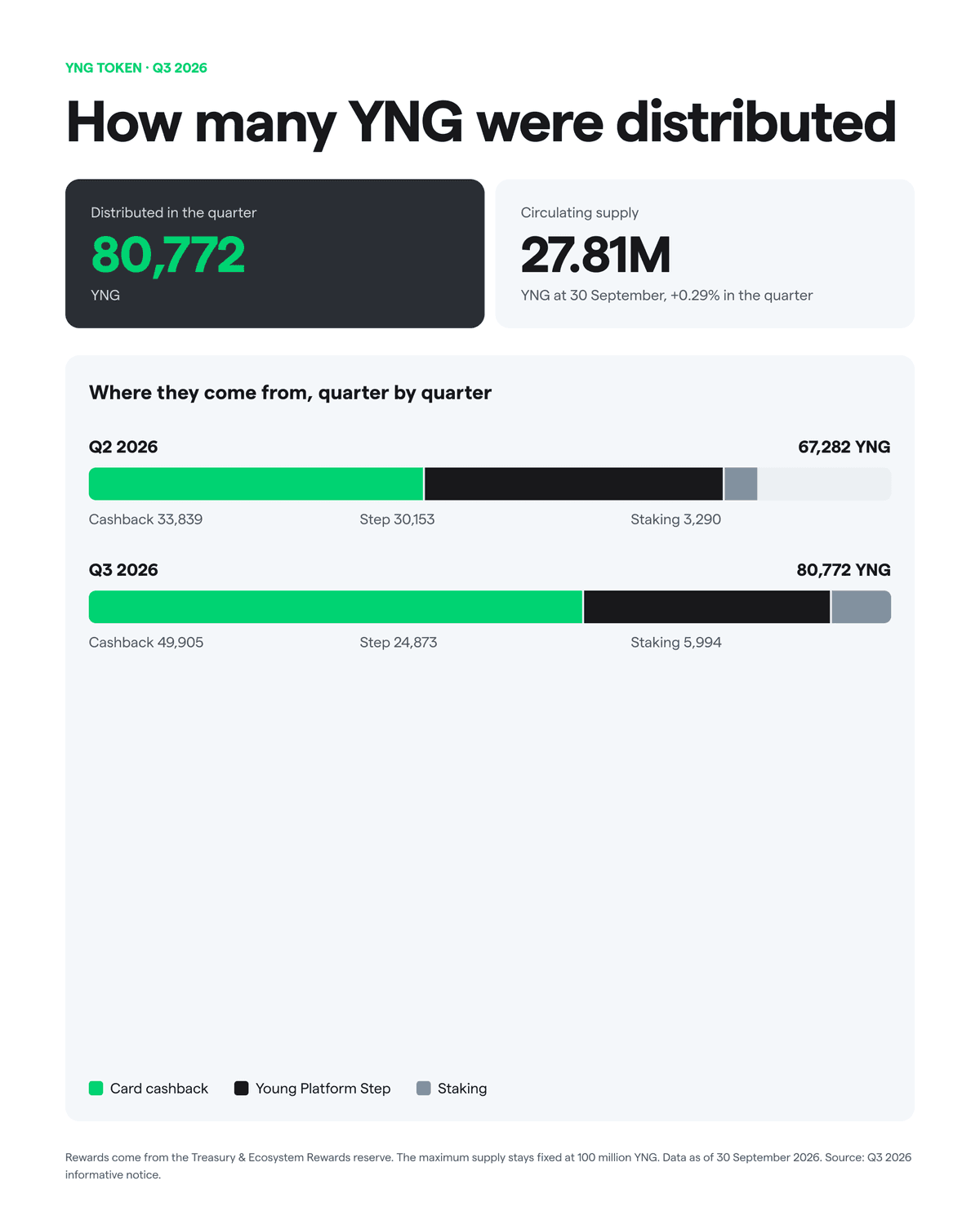
Between cashback, Step and staking, 80,772 YNG were distributed over the quarter, 20% more than the 67,282 of the second quarter. Here is where they come from:
- 49,905 YNG through card cashback;
- 24,873 YNG through Step;
- 5,994 YNG through staking.
The growth is almost entirely down to the card, while Step rewards decreased gradually over the last three months and staking had its best month in July. All these tokens come from the Treasury & Ecosystem Rewards reserve and not from the creation of new YNG: the maximum supply remains fixed at 100 million, with no mechanism that creates new ones beyond that threshold.
The Buyback Programme
And since we have mentioned it: the Buyback Programme is the mechanism by which part of the ecosystem’s revenues comes back to the token, in monthly cycles. First, the liquidity of the YNG/USDC pool on Uniswap is strengthened; then, with what is left over, YNG are bought back on the Uniswap pools. The repurchased tokens stay in the Buyback Wallet and the following month go back into the pool as liquidity: a cycle that feeds itself.
This quarter the cycle could be seen in full. In July we added to the YNG/USDC pool 478 YNG and 310 USDC, coming from the fees accrued by the pool itself, and with the remaining resources we bought back 8,993 YNG, for a value of about €5,204.
In August there was no buyback, because all the resources of the cycle went into liquidity: on 3 September 7,882 YNG and 4,943 USDC entered the pool, and those YNG came largely from the very tokens bought back the month before. The liquidity operations can be verified on-chain on the YNG/USDC pool.
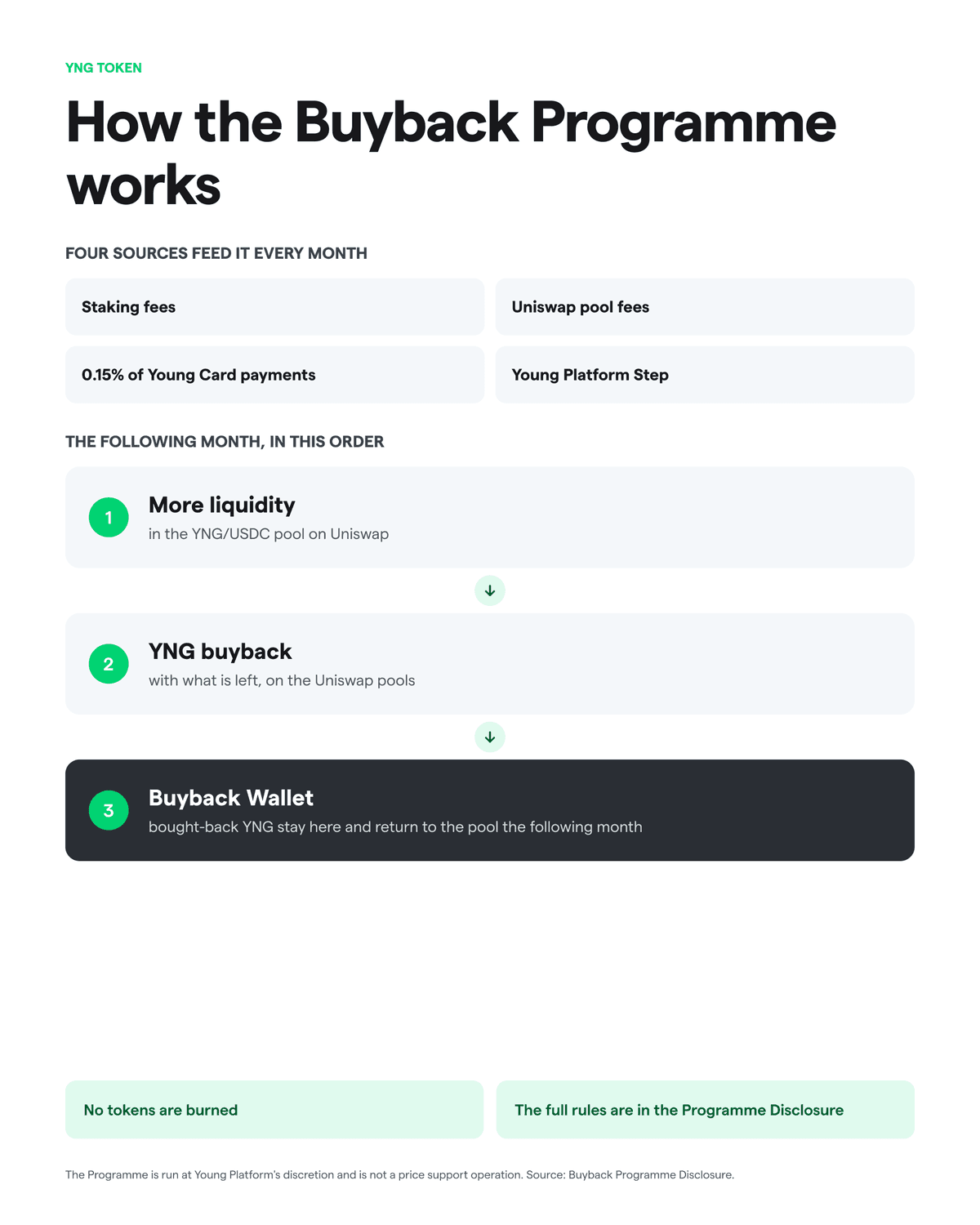
One thing we repeat in every report: the repurchased tokens are not burned at the moment. The Programme is run at the discretion of Young Platform, and the full rules are in the Buyback Programme Information Notice.
The Club numbers
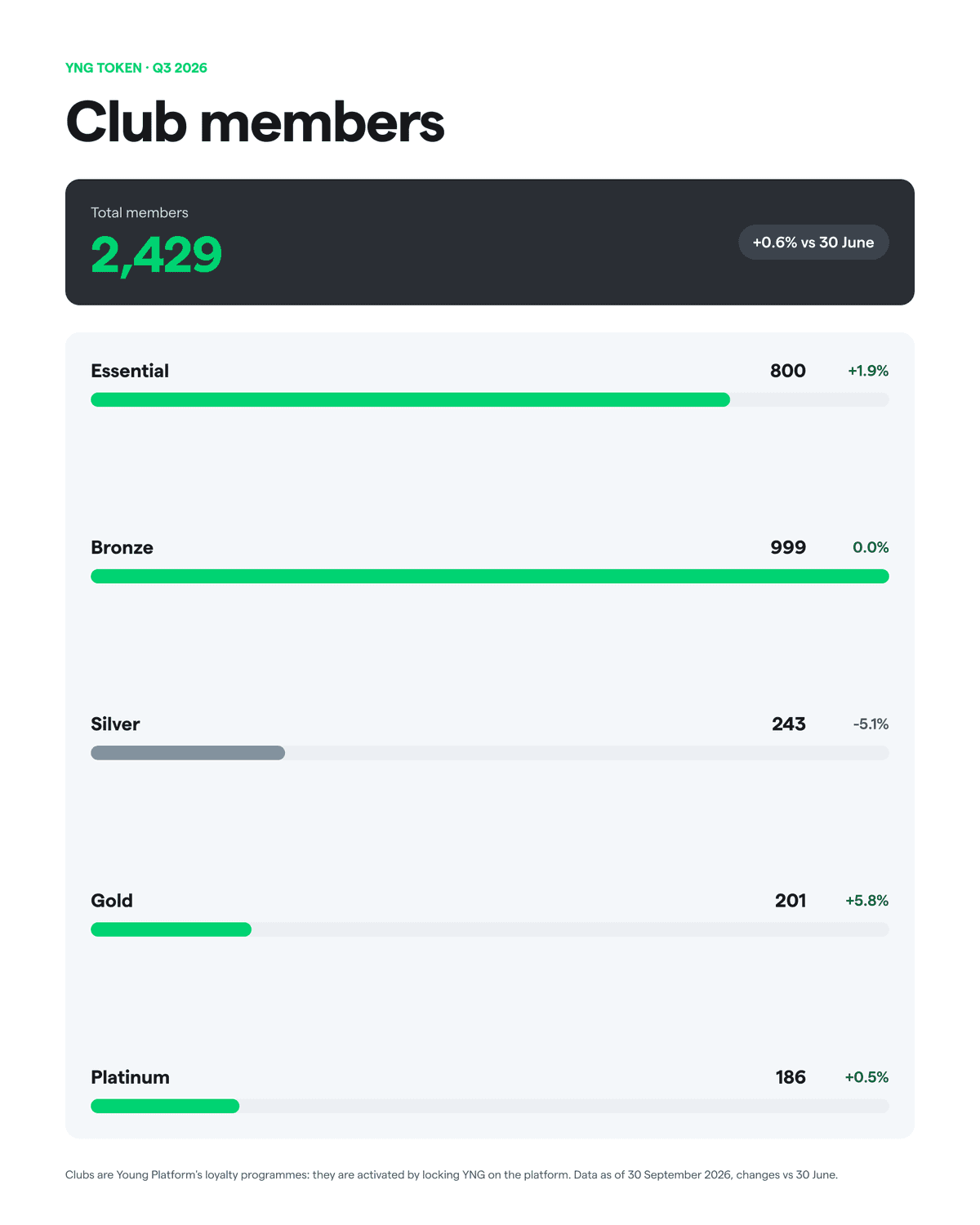
YNG gives access to the Clubs, Young Platform’s loyalty programmes, which offer benefits on our services and, from this quarter, also a dedicated Account Manager for the Gold and Platinum levels. At the end of September there are 2,429 Club members, 0.6% more than at the end of June, and together they keep about 8.57 million YNG locked on the platform. Growth is driven by the Gold and Essential levels. Here is how they are distributed (in brackets, the change compared with 30 June):
- Essential: 800 (+1.9%)
- Bronze: 999 (unchanged)
- Silver: 243 (-5.1%)
- Gold: 201 (+5.8%)
- Platinum: 186 (+0.5%)
The quarter’s other news
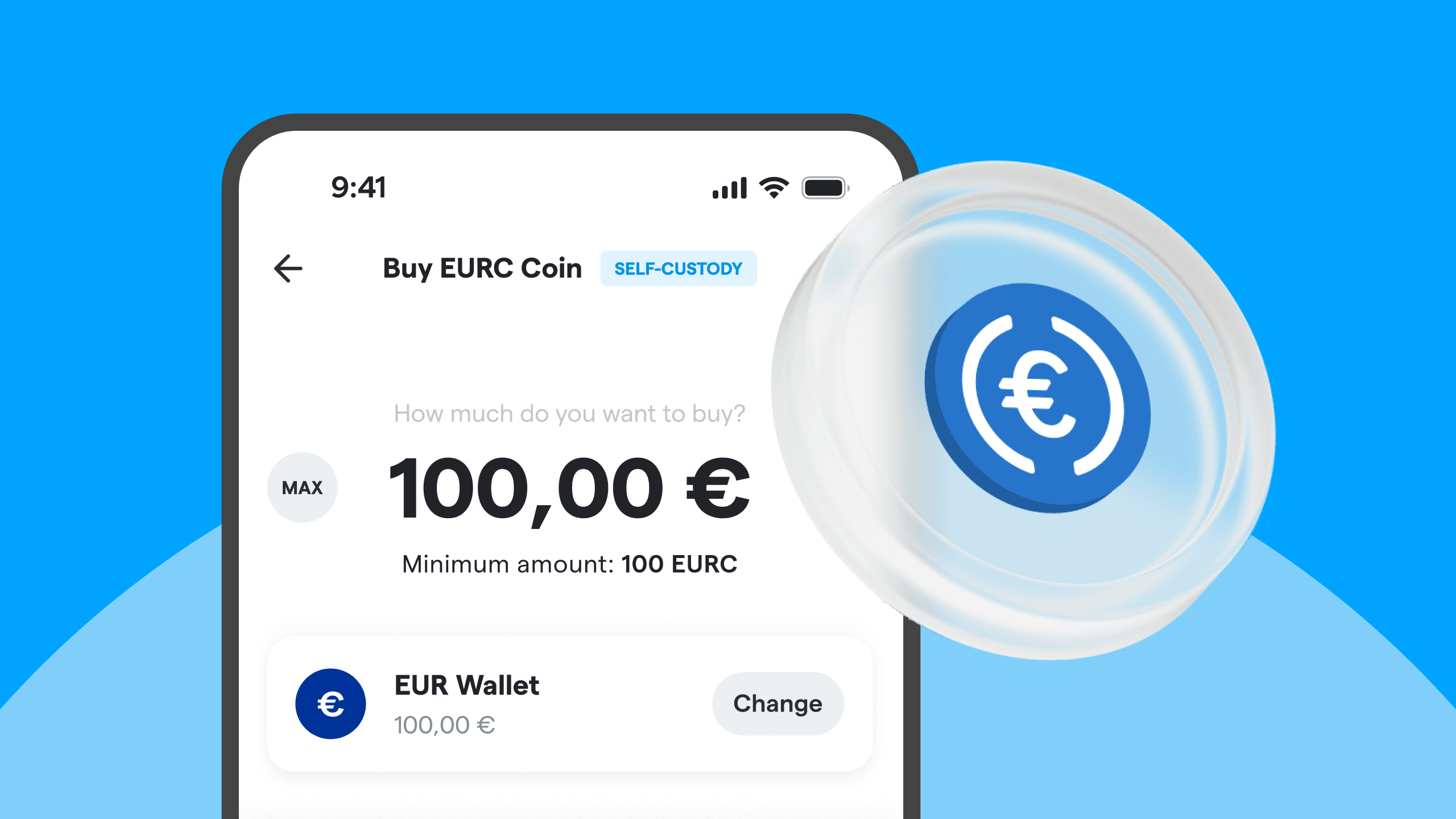
Since 11 September, you can buy and sell EURC on Young Platform, Circle’s euro stablecoin: it is also one of the two crypto-assets used by the DeFi Wallet protocols.
Since 27 July, Gold and Platinum Club members have had a dedicated Account Manager, a person who follows them in place of the old VIP support. And from 24 September to 31 October the Business Bonus 200+200 is active, celebrating three years of our services for businesses: €200 of Bonus Wallet for those who invite a company and the same amount for the company, under the conditions of the rules.
Young Platform Pro: towards the return of limit orders
Until June, on Young Platform Pro users’ orders were matched directly within the platform. With the MiCAR authorisation the model has changed: today, when you place an order, we execute it on your behalf on the external trading venues we are connected to, taking all the necessary steps to obtain the best possible result. It is the principle the regulation calls best execution: an extra protection for you on prices, costs and speed.
For market orders this step is immediate: the order goes out and is executed straight away. Limit orders work differently: they wait until the price reaches the level you have chosen, and only then are they executed on the external venues. To manage them with the same safeguards we had to redesign the infrastructure, and for this reason since the end of June we have suspended limit orders, conditional orders and the APIs.
We are working on it, and the goal is to bring limit orders back to Young Platform Pro by the end of 2026, with the same safeguards. This is forward-looking information: timing may change, and we will let you know in the app and on our channels as soon as they are available.
Administered tax regime: Young Platform will become a tax withholding agent
There is one piece of news that doesn’t concern YNG but concerns many of you, and it is perhaps the most awaited of the year. Every spring, those who hold crypto-assets find themselves reconstructing their transactions, calculating capital gains and filling in the RT section of the Italian tax return. From 1 January 2027, for those who choose the administered regime, we will do this work: Young Platform will become a tax withholding agent, calculate capital gains and losses, withhold the tax due and pay it directly to the Italian tax authorities.
Technically it is called the administered regime (regime amministrato), and it is the same mechanism that banks and brokers have used for years for shares and ETFs. It will be operational from the beginning of 2027. We will tell you how to join in the app and on our channels, as soon as the conditions are final.
And, again to make your life simpler, we are developing tools based on artificial intelligence to improve support and the experience on the platform.
It is the question you ask us most often, on Discord and during our live streams: why is there no longer a section on the token’s upcoming developments in the reports? There is only one answer, and it is the same for everything concerning YNG.
As the token’s issuer, we are subject to the MiCAR rules on market abuse. Information that can affect the price of YNG, once it can be disclosed, is published first of all in the Inside information section of the website, at the same time for everyone. Anticipating it in a report, a post or a live stream would mean giving someone an advantage over others: exactly what these rules are there to prevent.
If we don’t anticipate anything in reports or live streams, it is because, when an update is ready, the law requires everyone to learn about it at the same time. No advantage for the few.
As always, the report is only part of the story. We’ll tell you the rest live, on Wednesday 28 October at 18:00, in the YouTube live stream dedicated to the report.
This article is an overview. If you want the complete data, with all the on-chain addresses and regulatory references, you will find them in the official informational communication.
YNG token prices are expressed in euros, the currency of the YNG/EUR pair on Young Platform. On-chain data can be verified via block explorer. The Buyback Programme is run at the discretion of Young Platform S.p.A., is not a price support operation and does not guarantee any return. The DeFi Wallet is a service outside the MiCAR scope and does not benefit from the protections of Regulation (EU) 2023/1114.
Marketing communication pursuant to Art. 7 of Regulation (EU) 2023/1114 (MiCAR). It does not constitute crypto-asset advice, a personalised recommendation, or an offer or solicitation to invest. Young Platform S.p.A. is the issuer of the YNG Token, a utility token pursuant to Art. 3(1)(9) MiCAR. The characteristics, rights and risks of the token are described in the White Paper in force, available at storage.googleapis.com/young-documents/mica-whitepaper-YNG-token.xhtml; in the event of any discrepancy, the White Paper prevails. Crypto-assets are highly volatile and carry the risk of losing all or part of the capital invested; they are not covered by deposit guarantee schemes (Directive 2014/49/EU) or investor compensation schemes (Directive 97/9/EC). Past performance is not indicative of future results. Young Platform S.p.A., Via F. Cigna 96/17, 10155 Turin, Italy, PEC [email protected].
Related Article
Download the Young Platform app